

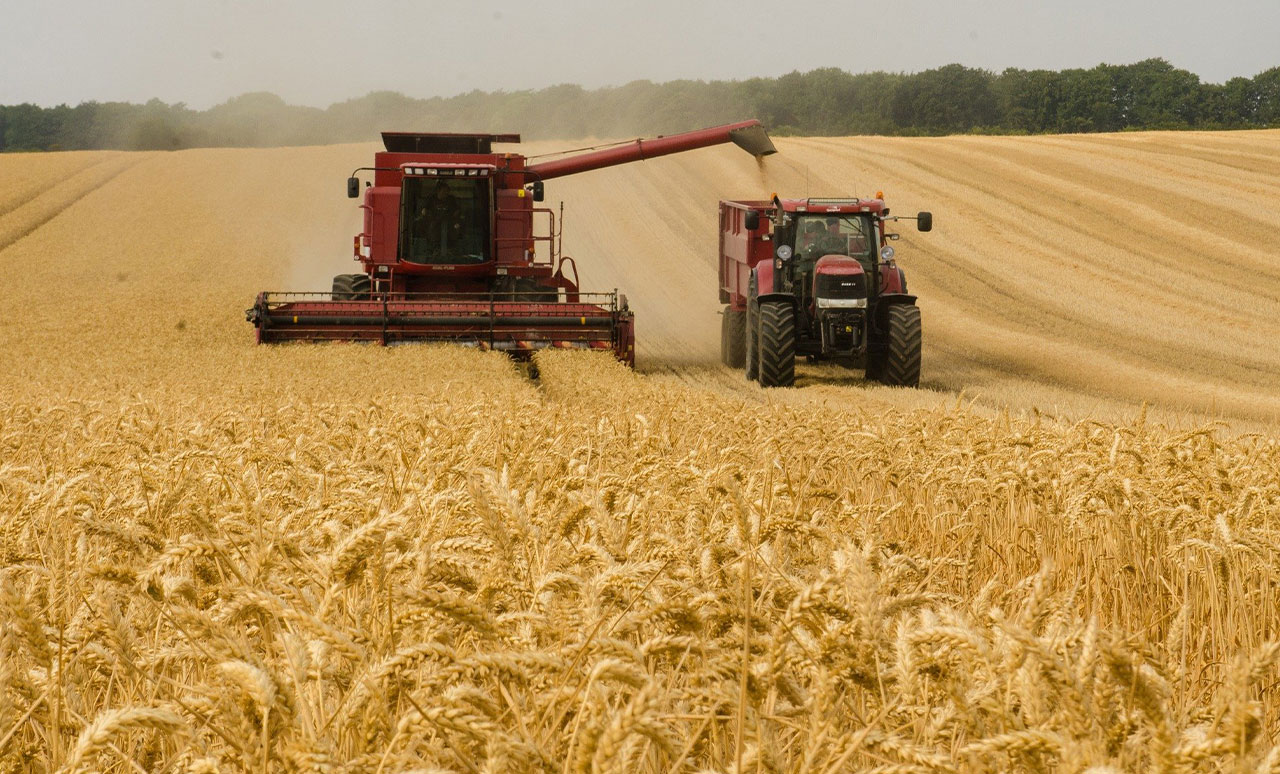


Foreign Policy, by Christina Lu: Russia’s invasion of Ukraine threatens to spark a global food crisis, as simultaneous disruptions to harvests and global fertilizer production are driving up food prices and sending economic shock waves throughout the world.
After a month of war, economists and aid agencies say the world is facing merging crises that could rapidly spiral into a global food emergency. The conflict has already slashed Russian and Ukrainian exports of crucial commodities such as wheat, sunflower oil, and corn, a disturbance that has rippled across import-reliant countries in the Middle East and North Africa. At the same time, the ongoing energy crunch has drastically increased fertilizer prices and transportation costs, squeezing the key inputs for global agricultural production.
These disruptions have converged in a “perfect storm,” said Ertharin Cousin, a distinguished fellow at the Chicago Council on Global Affairs and former executive director of the World Food Program. “That could result in a cataclysmic spike in food prices.”
Together, Russia and Ukraine account for roughly 30 percent of global wheat exports, while Russia is the world’s top fertilizer exporter. Both fertilizer and food prices have already climbed to record levels as the war impedes shipments and Western sanctions hit Russia. In the early weeks of the conflict, Kyiv also banned exports of wheat and other key food staples, while Moscow urged its fertilizer producers to temporarily suspend exports.
In the coming months, the United Nations’ Food and Agriculture Organization estimates that food prices could surge by as much as 20 percent, a significant spike that could exacerbate global food insecurity. Nearly 283 million people in 81 countries currently face acute food insecurity or are at high risk, according to the World Food Program, with 45 million on the brink of famine.
Russia’s invasion could be a “tipping point” into a world hunger crisis, Cousin said: “The entire global community will be hard hit by this.”
Rising food prices could also fuel political instability in import-reliant countries. Food prices and political unrest have historically been correlated with one another: A decade ago, skyrocketing grain costs—which drove bread prices up by 37 percent in Egypt—contributed to the Arab Spring. Earlier in 2008, spiraling prices spurred global riots and protests.
“People will react when they’re hungry … when the cost of food goes so high that they can’t afford the rent,” said Catherine Bertini, a distinguished fellow at the Chicago Council and also a former executive director of the World Food Program.
Surging prices have already sparked unrest in countries like Sudan, which imports more than 80 percent of its wheat from Russia and Ukraine. As bread prices rose, thousands of Sudanese demonstrators faced tear gas and bullets to protest. In recent weeks, protests have also rocked Iraq and Greece, where hundreds of farmers demonstrated against soaring fertilizer prices.
If these economic shocks continue, the instability could spread to other regions around the world, said Michael Tanchum, an energy expert at the European Council on Foreign Relations and the Middle East Institute. “This time around, it won’t be just an Arab Spring, it won’t be just North Africa, if measures aren’t taken,” Tanchum said.
Since global food markets were already strained by the COVID-19 pandemic, economists say the war’s economic fallout has been particularly painful—and especially so for nations that are heavily dependent on Russia and Ukraine’s supply. Almost 50 countries rely on Russia and Ukraine for at least 30 percent of their wheat imports and 26 depend on them for more than half of their imports.
“This is compounding an already bad situation,” said Chris Barrett, an agricultural economist at Cornell University. “The real worry right now is that the perfect storm comes as we still are not out of the woods from all of the massive economic displacement caused by the pandemic.”
The ongoing energy crunch has only intensified these pressures as skyrocketing natural gas prices drive up the costs of fertilizer production. Natural gas is required to make both ammonia and urea, key components in nitrogen-based fertilizers. To cope with these increased costs, some producers have resorted to slashing production. In March, fertilizer giant Yara International announced that it would have to operate at about half capacity in Europe to accommodate rising prices and planned maintenance.
A shock of “this magnitude has not been experienced before,” said Svein Tore Holsether, the CEO of Yara, who noted that roughly 80 percent of the cost of making nitrogen-based fertilizer comes from energy. “What we’re experiencing now are complete shutdowns of parts of the value chain.”
This disruption has strained countries like Brazil, which relies on Russia for over one-fifth of its fertilizer imports. Faced with a shrinking supply, Brazil, Argentina, Bolivia, Chile, Paraguay, and Uruguay pleaded to exclude fertilizer from Western sanctions on Russia in March. “Brazil depends on fertilizers,” Brazilian President Jair Bolsonaro told reporters. “It’s a sacred question for us.”
As the cutbacks and shortages bleed into the next planting season, experts warn that its impacts will be felt for months to come—and across a wide range of crops.
This fertilizer crunch “is going to impact every production in the world,” said David Laborde, a senior research fellow at the International Food Policy Research Institute. “It’s not just wheat.”
Aid agencies are now scrambling to secure sufficient funding to support the world’s most at-risk populations. Meeting the global need, however, may be challenging: In March, the World Food Program announced that it would need to raise an additional $71 million per month to purchase enough food. But as its resources are stretched by the war, the agency said, it has also been forced to reduce rations for refugees in the Middle East and Africa.
“We have no choice but to take food from the hungry to feed the starving,” David Beasley, the executive director of the World Food Program, said in a statement.
“The Russian attack on Ukraine was an attack on food insecure people everywhere in the world,” said Barrett, the agricultural economist. In the worst-case scenario, he said, “we are going to see tens of millions of people suddenly facing famine.”
Prophetic Link:
“My attention was then called from the scene. There seemed to be a little time of peace. Once more the inhabitants of the earth were presented before me; and again everything was in the utmost confusion. Strife, war, and bloodshed, with famine and pestilence, raged everywhere. Other nations were engaged in this war and confusion. War caused famine. Want and bloodshed caused pestilence. And then men’s hearts failed them for fear, ‘and for looking after those things which are coming on the earth.’” Testimonies to the Church, Vol. 1, page 268.2.
Comments