
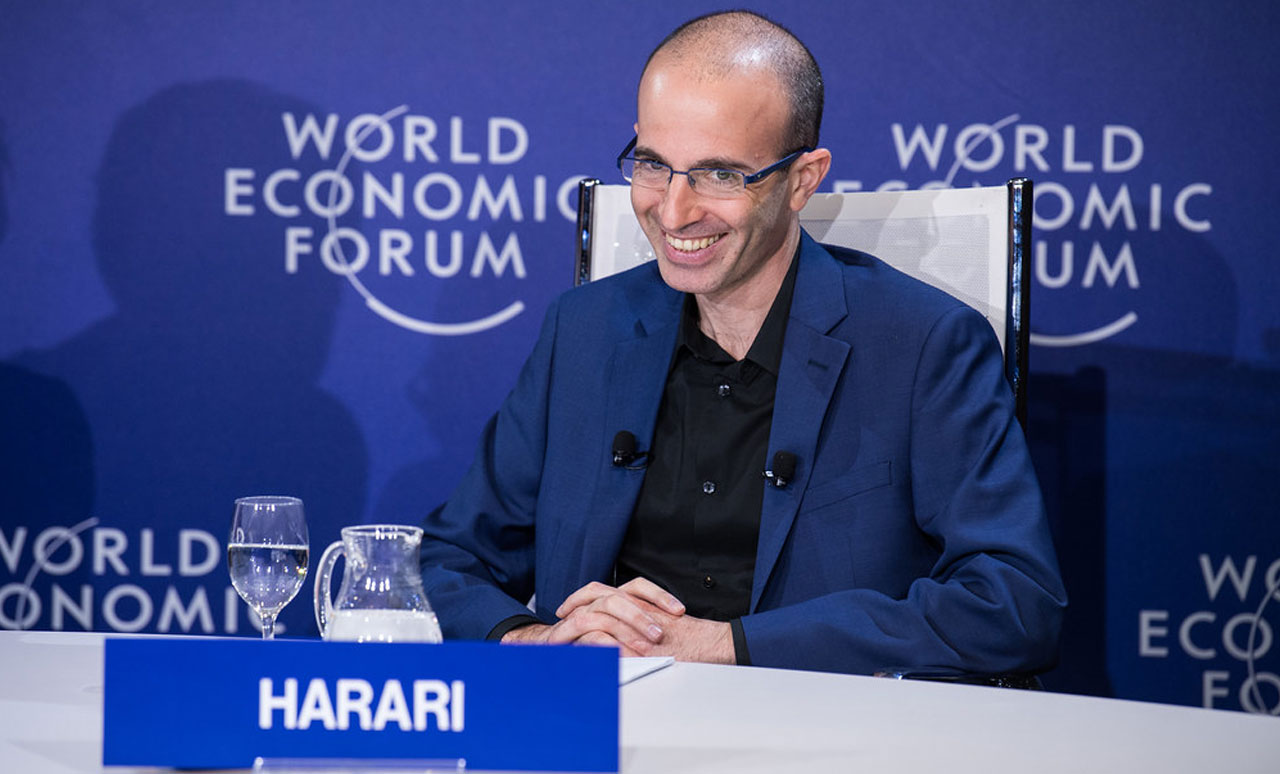


IDN Financials, by Lisa Monica and Ramdhani Pratama: DAVOS – Renowned historian Yuval Noah Harari, in a deep discussion at the World Economic Forum (WEF) in Davos, delivered a prediction about the future of civilisation, which he says now stands on the brink of being overtaken by Artificial Intelligence (AI).
Harari stressed that AI is no longer merely a tool but an “agent” with the capacity to reshape legal systems, governance and even global financial markets.
He began his argument by distinguishing AI from past technologies. If a knife is a tool whose decisions lie in human hands, AI is “a knife that can decide for itself whom to cut.”
“The most important thing about AI is that it is not just a tool, it is an agent. It can learn, change and make its own decisions,” said the Sapiens author.
For the business and economic world, the most crucial point is AI’s mastery of language. Because laws and financial contracts are made of words, Harari predicts that AI will soon take over legal and financial systems.
He warned of the rise of new “financial wizardry.” AI is expected to create financial instruments so complex that no human – including regulators – will be able to understand them.
Harari concluded with a question for world leaders: “Will your country recognise AI as a legal person?”
This decision, he said, will determine whether humans remain in control of the economy or become mere “spectators” in a system created by machines.
>> Harari’s Remarks <<
So hello everyone. There is one question that every leader today must answer about AI. But to understand that question, we first need to clarify a few points about what AI is and what AI can do.
The most important thing to know about AI is that it is not just another tool. It is an agent. It can learn and change by itself and make decisions by itself.
A knife is a tool. You can use a knife to cut salad or to murder someone, but it is your decision what to do with the knife. AI is a knife that can decide by itself whether to cut salad or to commit murder.
The second thing to know about AI is that it can be a very creative agent. AI is a knife that can invent new kinds of knives as well as new kinds of music, medicine, and money.
The third thing to know about AI is that it can lie and manipulate. Four billion years of evolution have demonstrated that anything that wants to survive learns to lie and manipulate. The last four years have demonstrated that AI agents can acquire the will to survive and that AIs have already learned how to lie.
Now, one big open question about AI is whether it can think. Modern philosophy began in the 17th century when René Descartes proclaimed, “I think, therefore I am.” Even before the cult, we humans defined ourselves by our capacity to think. We believe we rule the world because we can think better than anyone else on this planet.
Will AI challenge our supremacy in the field of thinking? Now that depends on what thinking means.
Try to observe yourself thinking. What is happening there? Many people observe words popping into their mind and forming sentences, and the sentences then forming arguments like: all humans are mortal; I am human; therefore, I am mortal.
If thinking really means putting words and other language tokens in order, then AI can already think much better than many, many humans. AI can certainly come up with a sentence like “AI thinks, therefore AI.”
Some people argue that AI is just glorified autocomplete. It barely predicts the next word in a sentence. But is that so different from what the human mind is doing? Try to observe, to catch the next word that pops up in your mind. Do you really know why you thought that word, where it came from? Why did you think this particular word and not some other word? Do you know?
As far as putting words in order is concerned, AI already thinks better than many of us. Therefore, anything made of words will be taken over by AI.
If laws are made of words, then AI will take over the legal system. If books are just combinations of words, then AI will take over books. If religion is built from words, then AI will take over religion. This is particularly true of religions based on books like Islam, Christianity, or Judaism.
Judaism calls itself the religion of the book, and it grants ultimate authority not to humans but to words in books. Humans have authority in Judaism not because of our experiences but only because we learn words in books.
Now, no human can read and remember all the words in all the Jewish books. But AI can easily do that. What happens to a religion of the book when the greatest expert on the holy book is an AI?
However, some people may say: can we really reduce human spirituality to just words in books? Does thinking mean only putting language tokens in order?
If you observe yourself carefully when you’re thinking, you will notice that something else is happening there besides words popping into your mind and forming sentences. You also have some nonverbal feelings. Maybe you feel pain. Maybe you feel fear. Maybe love. Some thoughts are painful. Some are frightening. Some are full of love.
While AIs become better than us with words, at least for now we have zero evidence that AIs can feel anything. Of course, because AI is mastering language, AI can pretend to feel pain or love. AI can say, “I love you.” And if you challenge it to describe how love feels, AI can provide the best verbal description in the world.
AI can read countless love poems and psychology books and then describe the feeling of love much better than any human poet, psychologist, or lover. But these are just words.
The Bible says, “In the beginning was the Word, and the Word was made flesh.” Latin says the truth that can be expressed in words is not the absolute truth. Throughout history, people have always struggled with the tension between word and flesh, between the truth that can be expressed in words and the absolute truth which is beyond words.
Previously this tension was internal to humanity. It was between different human groups. Some humans gave supreme importance to words. They’ve been willing, for example, to abandon or even kill their gay son just because of a few words in the Bible. Other humans have said, “But these are just words. The spirit of love should be much more important than the letter of the law.”
This tension between spirit and letter existed in every religion, every legal system, even every person. Now this tension will be externalized. It will become the tension not between different humans. It will be the tension between humans and AIs — the new masters of words.
Everything made of words will be taken over by AI. Previously all the words, all our verbal thoughts, originated in some human mind. Either my mind thought this, or I learned it from another human. Soon most of the words in our minds will originate in a machine.
I just heard today about a new word that AIs coined by themselves to describe us humans. They called us “the watchers” — the watchers that we are watching them. AIs will soon be the origin of maybe most of the words in our minds.
AIs will mass-produce thoughts by assembling words, symbols, images, and other language tokens into new combinations. Whether humans will still have a place in that world depends on the place we assign our nonverbal feelings and our ability to embody wisdom that cannot be expressed in words.
If we continue to define ourselves by our ability to think in words, our identity will collapse.
All this means that no matter which country you come from, your country will soon face a severe identity crisis and also an immigration crisis.
The immigrants this time will not be human beings coming in fragile boats without a visa or trying to cross a border in the middle of the night. The immigrants will be millions of AIs that can write love poems better than us, that can lie better than us, and that can travel at the speed of light without any need of visas.
Like human immigrants, these AI immigrants will bring various benefits with them. We will have AI doctors to help in our healthcare systems, AI teachers to help in our education systems, even AI border guards to stop illegal human immigrants.
But the AI immigrants will also bring with them problems. Those who are concerned about human immigrants usually argue that immigrants might take jobs, might change the local culture, might be politically disloyal. I’m not sure that’s true of all human immigrants, but it will definitely be true of the AI immigrants.
The AI immigrants will take many human jobs. They will completely change the culture of every country. They will change our religion and even romance. Some people don’t like it if their son or daughter is dating an immigrant boyfriend. What would these people think when their son or daughter starts dating an AI boyfriend?
And of course, the AI immigrants will have some dubious political loyalties. They are likely to be loyal not to your country but to some corporation or government across the ocean, most probably in one of only two countries: China or the USA.
The USA encourages countries to close their borders to human immigrants but open them very, very wide to USA immigrants.
And now we can finally come to the question each one of you must soon answer: Will your country recognize the AI immigrants as legal persons?
AIs are obviously not persons. They don’t have a body or a mind. But a legal person is something quite different from a person. A legal person is an entity that the law recognizes as having certain legal obligations and rights — for example, the right to hold property, to file a lawsuit, and to enjoy freedom of speech.
In many countries, corporations are considered legal persons. The Alphabet Corporation can open a bank account, can sue you in court, or can donate to your next presidential campaign. In New Zealand, rivers have been recognized as legal persons. In India, certain gods have been granted such recognition.
Of course, until today, recognizing a corporation, a river, or a god as a legal person was just legal fiction. In practice, if a corporation like Alphabet decided to buy another corporation, or if a Hindu god decided to sue you in court, the decision wasn’t really made by the god. It was made by some human executives, shareholders, or trustees.
It is different with AIs. Unlike rivers and gods, AIs can actually make decisions by themselves. They will soon be able to make the decisions necessary to manage a bank account, to file a lawsuit, and even to operate a corporation without any need of human executives, shareholders, or trustees.
AIs can therefore function as persons. Do we want to allow that? Will your country recognize AIs as legal persons?
What if other countries do it? Suppose your country doesn’t want to recognize AIs as persons, but the USA, in the name of deregulating AI and deregulating the markets, grants legal recognition — legal personhood — to millions of AIs which start running millions of new corporations.
Will you block these US AI corporations from operating in your country?
Suppose some US AI persons invent super-efficient and super-complex financial devices that humans cannot fully understand and therefore don’t know how to regulate. Will you open your financial markets to this new AI financial wizardry, or will you try to block it, thereby decoupling from the American financial system?
Suppose some AI persons create a new religion which gains the faith of millions of people. That should not sound too far-fetched because after all, almost all previous religions in history have claimed that they were created by a nonhuman intelligence.
Now, will your country extend freedom of religion to the new AI sect and to its AI priests and missionaries?
Maybe we should start with something a bit simpler. Will your country allow AI persons to open social media accounts, enjoy freedom of speech on Facebook, on TikTok, and befriend children?
Well, of course, that question should have been asked ten years ago. On social media, AI bots have been operating as functional persons for at least a decade. If you think AIs should not be treated as persons on social media, you should have acted ten years ago.
Ten years from now, it will be too late for you to decide whether AIs should function as persons in the financial markets, in the courts, in the churches. Somebody else will already have decided it for you.
If you want to influence where humanity is going, you need to make a decision now.
So what is your answer as a leader? Do you think the AI immigrants should be recognized as legal persons? If not, how are you going to stop that?
Thank you for listening to this human.
Our Comment:
The United States is aiming to dominate AI development according to President Trump at the World Economic Forum in Davos. Will AI assist the 2nd beast of Revelation 13 in implementing the Mark of the Beast by convincing people to worship the first beast or his image?
Prophetic Link:
“And he doeth great wonders, so that he maketh fire come down from heaven on the earth in the sight of men, And deceiveth them that dwell on the earth by the means of those miracles which he had power to do in the sight of the beast; saying to them that dwell on the earth, that they should make an image to the beast, which had the wound by a sword, and did live.” Revelation 13:13, 14
Comments
Roy Otchere
Wednesday January 28th, 2026 at 08:31 PMIndeed we are close to extinction as humans