

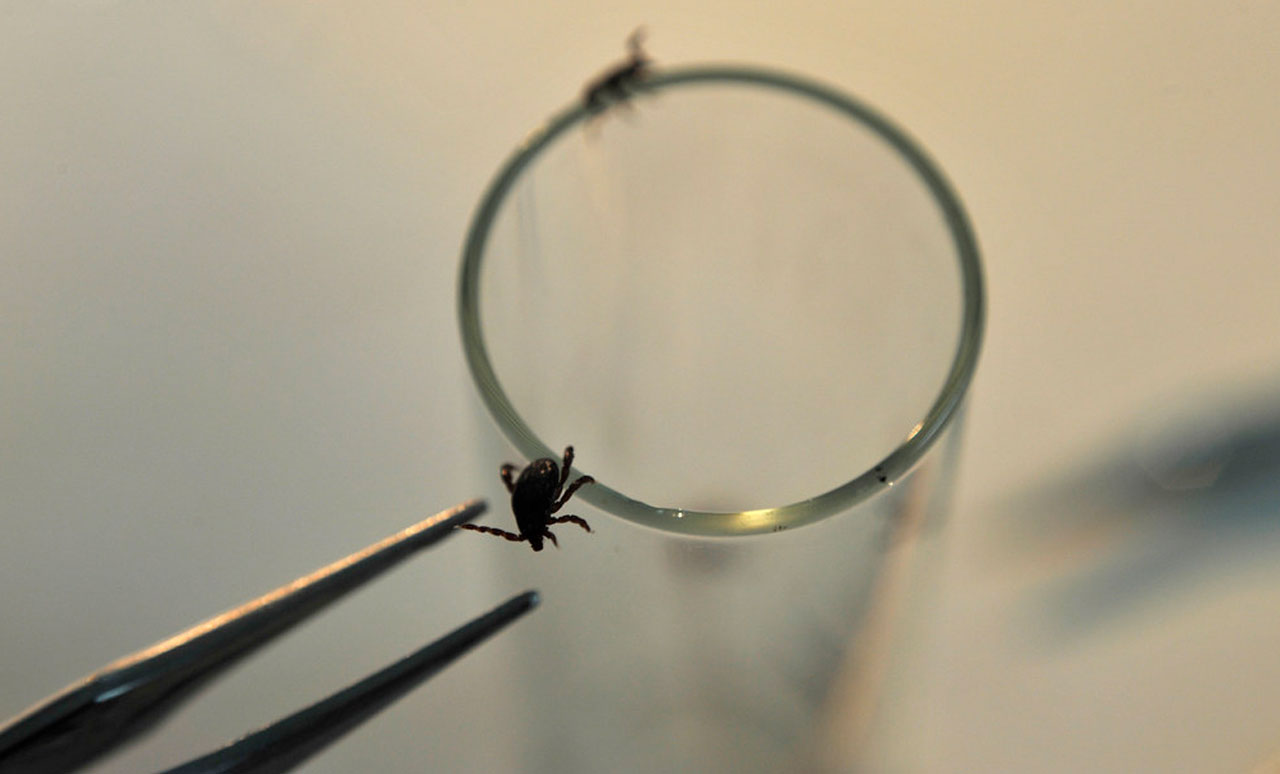


NBC News, by Fiona Bork: An invasive tick species is creeping its way into more parts of the country as warming temperatures help it spread a little-known infection that can leave people with debilitating symptoms and, in rare cases, dead.
In May, scientists at the Connecticut Agricultural Experiment Station in New Haven discovered for the first time that the longhorned tick had become a carrier for the bacterium that causes the Ehrlichiosis infection. With cases already on the rise, that was a big cause of concern.
“I am afraid to say that it is a storm brewing,” said Goudarz Molaei, the director of the lab’s tick-testing program. “Climate change eventually will almost eliminate winter in our region. And this tick, like other tick species, will be active year-round.”
Warming temperatures, which have already translated into shorter winters, allow the longhorned tick and other tick species to wake up early from hibernation, increasing the risk of getting bitten.
The longhorned tick, which is native to East Asia, first invaded places like Australia, New Zealand and the Pacific Islands. It has now been detected in at least 21 states, with Michigan reporting its first sighting at the end of June. Researchers aren’t sure how the tick made it to the United States, but it’s likely it arrived on the backs of imported livestock or other animals.
In 2017, scientists identified the country’s first longhorned tick in New Jersey, though it’s likely the species has been in the United States since at least 2010.
“The fact it was here for so long without us actually knowing about it was really a wakeup call,” said Dana Price, an associate research professor in the entomology department at Rutgers University.
Modeling indicates areas from southern Canada throughout the continental United States are environmentally suitable to the longhorned tick.
That means the threat is twofold: The longhorned’s geographic range is expanding, and so is the time that it’s active and able to transmit disease, scientists said.
Ehrlichiosis is becoming so prevalent that there is a region of the country unofficially named after it: The “Ehrlichiosis Belt” stretches from as far north as Connecticut and New York to as far west as Arkansas.
The lone star and blacklegged ticks have long carried Ehrlichia chaffeensis, the bacterium that causes Ehrlichiosis. The infection sends about 60% of patients to the hospital and kills about 1 in 100 patients, according to the Center for Disease Control and Prevention. Infected people will typically experience fever, chills, muscle aches, headaches and fatigue one to two weeks after having been bitten. But if people aren’t treated quickly, the infection can sometimes lead to brain and nervous system damage, respiratory failure, uncontrolled bleeding and organ failure.
The number of Ehrlichiosis cases has risen steadily since 2000, when the CDC reported 200 cases, compared with 2,093 in 2019. Studies suggest that the number of annual Ehrlichiosis cases is grossly underreported, with one study from Rutgers University researchers saying 99% of cases go undetected.
The CDC reported this month that there were more emergency room visits in July for tick bites than the past eight Julys. In early July, officials closed Pleasure Beach, a popular swim spot in Bridgeport, Connecticut, for the summer after they discovered an infestation of several tick species, including the longhorned tick.
Manisha Juthani, the commissioner of the Connecticut Department of Public Health, said that as climate change makes “tick season” less predictable, Connecticut residents should take precautions like wearing long pants and tucking them into their socks and conducting tick checks on family members and pets after having been outdoors for extended periods of time.
“The reality is that with the changes we’re seeing in climate, we have to be more prepared and more aware of the infections and the pathogens that we can be exposed to by being outside and potentially being aware of the things that can really cause the most harm to people,” Juthani said.
While longhorned ticks often prefer the blood of livestock to humans, entomologists say their unique biology makes them a formidable public health hazard. They can establish populations of thousands from a single female because, like bees, they have the ability to reproduce without mates.
They can also ingest and become carriers for pathogens typically carried by other tick species if they happen to feed on the same host. The process, known as co-feeding transmission, is common among most tick species.
Molaei said his recent discovery of the Ehrlichiosis-causing bacterium in the longhorned tick raises concerns about what other pathogens the tick may be able to contract and transmit to humans. The longhorned tick and the lone star tick, one of the original carriers of Ehrlichia, both feed on similar hosts, like white-tailed deer.
“We live in this part of the world with several important tick species, and we have to learn how to live with this many ticks,” Molaei said. “And the key is to protect ourselves.”
The World Health Organization reports that more than 17% of infectious diseases globally are transmitted through vectors, intermediary animals that ferry viruses, bacteria and other pathogens from one animal to the next. Tick-borne diseases in the United States accounted for 77% of vector-borne disease reports from 2004 to 2016, with cases more than doubling in the last 13 years, according to data collected by the CDC.
Jennifer Platt was bitten by a tick during that time. She contracted Ehrlichiosis from a tick bite in North Carolina in the summer of 2011.
When she couldn’t pick up and carry her 2-year-old son, a friend who is a nurse suggested she go to the hospital immediately. The friend suspected Platt might have a tick-borne infection.
Platt was sick and on antibiotics for months after her diagnosis. Her shoulder locked because of the infection — a rare but contractable chronic symptom of tick-borne disease — leading to months of physical therapy and putting her out of work for three months.
It took her more than a year to fully recover from the lasting impacts of the infection.
“The best way I’d describe it,” she said, “is I felt like death.”
A few years after she started feeling better, she was diagnosed with Lyme and Babesiosis diseases — which she attributes to the same tick bite.
Platt, who co-founded the nonprofit advocacy organization Tick-Borne Conditions United, said she hopes the recent discovery of the Ehrlichia bacterium in the longhorned tick will help raise awareness among doctors and the general public about the threat of tick-borne diseases, especially little-known ones like Ehrlichiosis.
“My mission in life is to support people in being who they are,” Platt said. “And if you’re sick from a tick-borne disease, you can’t be who you are.”
Prophetic Link:
“The people of God will not be free from suffering; but while persecuted and distressed, while they endure privation and suffer for want of food they will not be left to perish. That God who cared for Elijah will not pass by one of His self-sacrificing children. He who numbers the hairs of their head will care for them, and in time of famine they shall be satisfied. While the wicked are dying from hunger and pestilence, angels will shield the righteous and supply their wants. To him that “walketh righteously” is the promise: “Bread shall be given him; his waters shall be sure.” “When the poor and needy seek water, and there is none, and their tongue faileth for thirst, I the Lord will hear them, I the God of Israel will not forsake them.” Isaiah 33:15, 16; 41:17.” Great Controversy, 629.2
Comments