
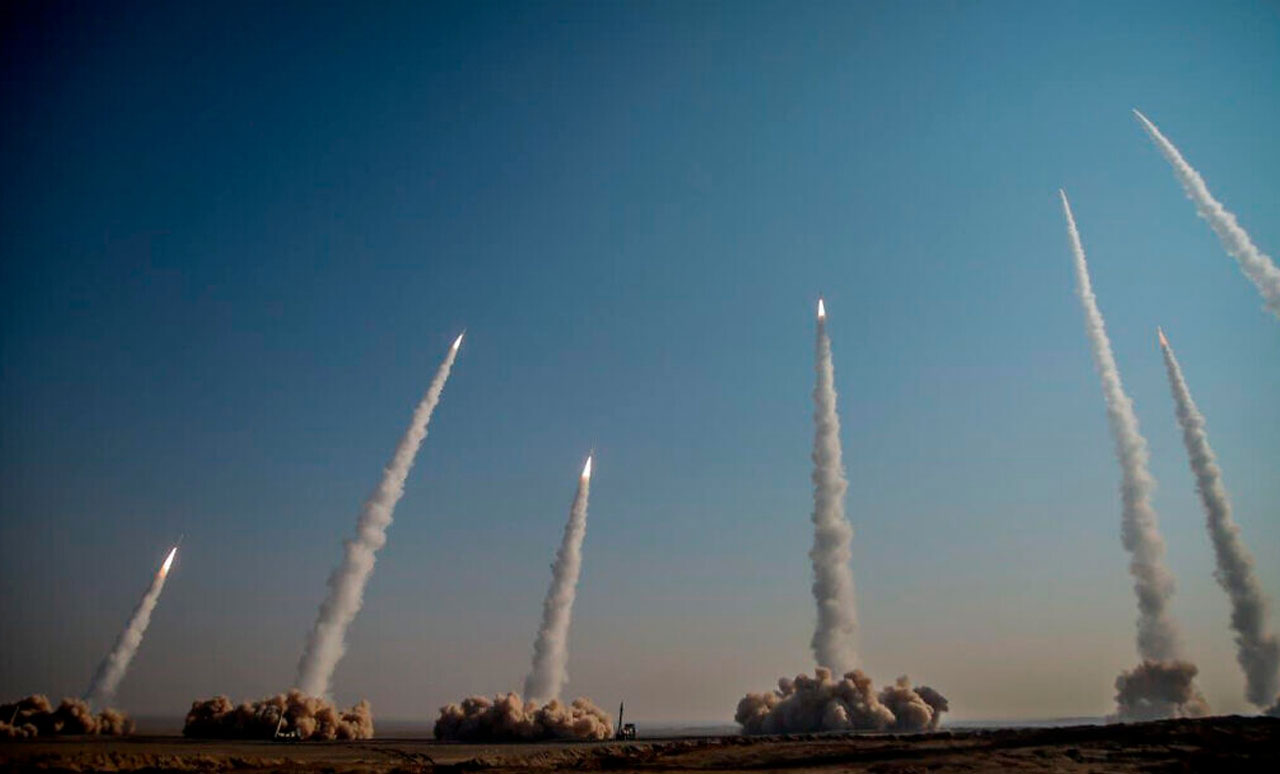
Interesting Engineering, Kaif Shaikh: The expanding conflict between Iran on one side and the United States, Israel, and several Gulf states on the other is increasingly being described by analysts as a war of numbers. While air superiority has allowed U.S. and Israeli forces to strike hundreds of targets across Iran, Tehran has responded with waves of missiles and drones aimed at military facilities and infrastructure across the Middle East.
Iran has launched more than 500 ballistic missiles and over 2,000 drones since the campaign began, according to U.S. Central Command commander Adm. Brad Cooper, who revealed the figures on March 3. At the same time, U.S. and allied forces have fired thousands of precision-guided munitions while intercepting incoming threats across multiple countries.
This exchange is gradually turning into what analysts call a “missile math” problem: how long each side can sustain the pace of launches and interceptions before critical stockpiles begin to run dry.
With Iran signaling that it has prepared for a long conflict and Western officials increasingly discussing interceptor shortages, the depth of each side’s arsenal may play a decisive role in determining how the war unfolds.
A conflict increasingly defined by stockpiles
Military analysts say the war is increasingly shaped by a basic question of inventory. Who can sustain the exchange of missiles longer?
According to The Guardian, the conflict has evolved into what Stacie Pettyjohn, director of the defense program at the Center for a New American Security, described as “a bit of a salvo competition,” a term referring to exchanges of large volleys of precision weapons between opposing forces.
“The question is who has the deeper magazines of key weapons, and the big unknown is how deep Iran’s inventories are,” Pettyjohn said. Iran’s strategy reflects the imbalance in conventional military power. Its air force is largely outdated and unable to compete directly with Israeli or American aircraft. Instead, Tehran has relied heavily on missiles and drones to retaliate across a wide geographic area.
Since the start of the campaign, Iranian attacks have targeted U.S. and allied facilities across a vast region stretching roughly 1,200 miles. Targets have included sites in Qatar, the United Arab Emirates, Bahrain, Kuwait, Iraq, and Oman. At the same time, U.S. and Israeli strikes have hit hundreds of locations inside Iran, including missile launchers, storage facilities, and command structures.
Despite these attacks, Iran has continued launching missiles and drones, raising questions about how large its remaining arsenal may be.
The cost imbalance of modern air defense
While Iran’s missile and drone arsenal remains difficult to quantify, Western officials are increasingly focused on the cost and availability of defensive interceptors.
As reported by CNN, at least one Gulf ally has already begun running low on interceptor munitions used to defend against Iranian missile and drone attacks.
“It’s not panic yet, but the sooner they get here, the better,” one regional source told the network, referring to a request made to the United States for additional interceptors. The challenge stems partly from the economics of modern warfare. Analysts estimate that intercepting drones and missiles can cost significantly more than producing them.
Kelly Grieco, a strategic and military analyst at the Stimson Center, told The Guardian that intercepting a drone can cost roughly five times as much as manufacturing one.
Production rates also favor Iran’s strategy. Secretary of State Marco Rubio said Iran may be producing “over 100 of these missiles a month,” while interceptor production can be far slower.
“Compare that to the six or seven interceptors that can be built a month,” Rubio said, according to CNN. These disparities are forcing military strategists to consider how long current defenses can sustain the pace of interception.
Signs of strain on interceptor supplies
The scale of the missile exchange is already consuming significant quantities of defensive munitions. According to a report by the Missile Defense Project at the Center for Strategic and International Studies, the United States fired between 20% and 50% of its available THAAD missile interceptors during the previous 12-day war between Israel and Iran.
Earlier assessments suggested the United States also used roughly 20% of its expected Standard Missile-3 interceptors during that conflict. Such usage rates are concerning because interceptor production has historically lagged behind operational demand.
Retired U.S. Air Force Secretary Frank Kendall said that the most advanced long-range precision weapons are among the most expensive and least abundant.
“These are the more expensive, sophisticated weapons we don’t have as large a stockpile of,” Kendall told CNN, adding that drawing them down significantly could increase risks in other regions. Even before the current conflict, U.S. military leaders had warned that extended campaigns could strain stockpiles needed for other regions, including a potential conflict with China.
Iran signals preparation for a long war
Iranian officials have suggested that the country may deliberately be pacing its missile use. On March 3, Iranian Defense Ministry spokesperson Reza Talaei-Nik said the country had prepared for a prolonged confrontation.
“We have the capacity to resist and to continue an offensive defense longer than what [the enemy] has planned for this imposed war,” Talaei-Nik said in comments reported by the state news agency IRNA.
He added that Iran does not intend to deploy its most advanced weapons immediately. “We do not intend to deploy all our advanced weapons and equipment in the first days.”
A day earlier, Ali Larijani, secretary of Iran’s Supreme National Security Council, repeated that message, saying the country had prepared for a longer conflict. “Iran, unlike the United States, has prepared itself for a long war,” Larijani said.
The Institute for the Study of War has noted that Iran may currently be using older missile systems, including Shahab and Zolfaghar variants, while keeping newer systems such as the Fattah-2 in reserve.
Inside Iran’s layered missile and drone arsenal
Iran’s response relies on a wide range of domestically produced weapons designed to strike quickly and complicate interception. As previously reported by Interesting Engineering, Tehran’s retaliatory capability is built around short- and medium-range ballistic missiles, cruise missiles, and long-range attack drones operating together as a layered strike system.
Short-range missiles such as the Fateh-110, Zolfaghar, and Qiam-1 are used for rapid strikes against nearby targets. These solid-fuel systems can be launched quickly and from mobile platforms, reducing the warning time available to air defense systems.
For longer distances, Iran deploys medium-range missiles including the Ghadr, Emad, and Khorramshahr series. The Khorramshahr missile can carry a warhead weighing up to 1,500 kilograms and reach targets roughly 2,000 kilometers away, placing Israel and U.S.-linked bases across the Gulf within range. Iran has also unveiled a newer variant known as the Kheibar (Khorramshahr-4), which retains a similar range but is designed to deliver one of the largest warheads in Iran’s missile arsenal, increasing its destructive potential against hardened targets.
Newer systems, including the Fattah series, incorporate maneuverable reentry vehicles that can adjust their flight path near the end of their trajectories. Traveling at speeds estimated between Mach 13 and Mach 15, these weapons are designed to complicate interception by advanced defense systems.
Alongside ballistic missiles, Iran has increasingly relied on cruise missiles such as the Paveh, Soumar, and Hoveyzeh, which fly at low altitudes and follow terrain contours to avoid radar detection.
Large numbers of one-way attack drones also play a central role. Shahed drones, capable of ranges exceeding 2,500 kilometers, are often launched in coordinated groups to saturate air defenses and create openings for missile strikes. This combination of weapons allows Iran to maintain pressure while increasing the cost of interception for its opponents.
A war of attrition in the skies
Analysts say the result is a conflict increasingly shaped by attrition, or gradual weakening rather than decisive battlefield victories. Tal Inbar, a senior research fellow at the Missile Defense Advocacy Alliance, told The Guardian that no air defense system can provide complete protection. “There is no such thing as 100% defence. It’s a war of attrition,” Inbar said.
Even a single missile that penetrates defenses and strikes infrastructure such as hospitals, power plants, or universities could impose high costs. For Iran, sustaining smaller but continuous barrages may be more effective than large one-time strikes.
“The Iranians know this,” Grieco told The Guardian. “They are aiming to keep the campaign running. It’s death by a thousand cuts.” That approach forces the United States, Israel, and their partners to continue intercepting incoming threats while also carrying out offensive strikes, steadily consuming their own munitions.
The decisive factor may be endurance
If current trends continue, the war may ultimately hinge less on battlefield maneuver and more on logistical endurance. Should Iran’s missile inventory collapse, analysts say Tehran may be forced to halt attacks and seek negotiations. But if interceptor supplies run low first, the calculus could shift.
Pettyjohn told The Guardian that declining interceptor stockpiles could pressure the United States and its allies to reconsider the scale of their operations.
If defensive munitions begin running out, she said, that could push some participants toward negotiations. In that sense, the conflict is increasingly defined not only by military capability but by industrial capacity, the ability to produce missiles, interceptors, and precision weapons faster than they are used.
As the war enters its next phase, the side with the deeper arsenal may ultimately determine who fights till the end.
Prophetic Link:
“Satan delights in war, for it excites the worst passions of the soul and then sweeps into eternity its victims steeped in vice and blood. It is his object to incite the nations to war against one another, for he can thus divert the minds of the people from the work of preparation to stand in the day of God.” Darkness Before Dawn, 33.2


Comments